
My name is Brenden Hartung, and I am currently studying for a Bachelor’s of Science in Electrical Engineering at Virginia Tech. Thank you for taking the time to view my portfolio!
About Me
Growing up, I knew I wanted to be an engineer so I could make a career out of my love of computers, technology, and problem solving. This led me to attend the Roanoke Valley Governor’s School for Science and Technology (RVGS), where I was introduced to the engineering process, computer programming, and higher level sciences.
Following my time at RVGS, I started at Virginia Tech, where I currently study full time. In addition to my BSEE, I am considering graduate level education and Professional Engineer licensure.
Each project section below goes through the problem, design, and implementation of the project in question.
Overview
This was a personal project given to my girlfriend. This project was open-ended in requirements, forcing me to lay the design criteria myself.
The goal of this project was to design and construct a light-up ornament with the capability for momentary electrical power. The electrical component of this project was used to drive a set of LEDs, while physical fabrication was used for the ornament itself.
Requirements/Constraints
- To complete this project, a battery-powered circuit needed to be housed within a physical component.
- Given the resources available, a 3D printed part was deemed the best option for construction.
- On the circuit level, the design needed to handle momentary pulses of current controlled by a switch mounted on the exterior of the build.
Design Process
- A basic circuit design was completed. This included two arrays of 5 LEDs, a momentary switch to control the circuit, and 2 3V CR2032 batteries.
- A CAD model of the ornament was designed in SOLIDWORKS, including cutouts for the switch and LEDs, and a pair of battery shelves.
- After modeling, the circuit was soldered together on a custom PCB board fabricated via V-scoring.
- The CAD parts were 3D printed. Notably, the tolerances available allowed for friction fits instead of requiring adhesives.
- The ornament was assembled by putting electrical pieces into place and then enclosing the circuitry with the remaining CAD pieces.
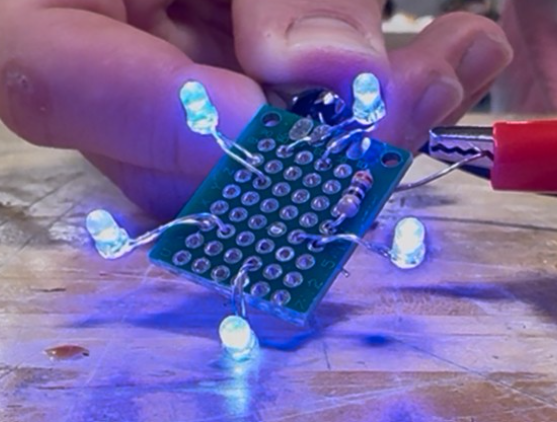
An early model of an LED array used for this project
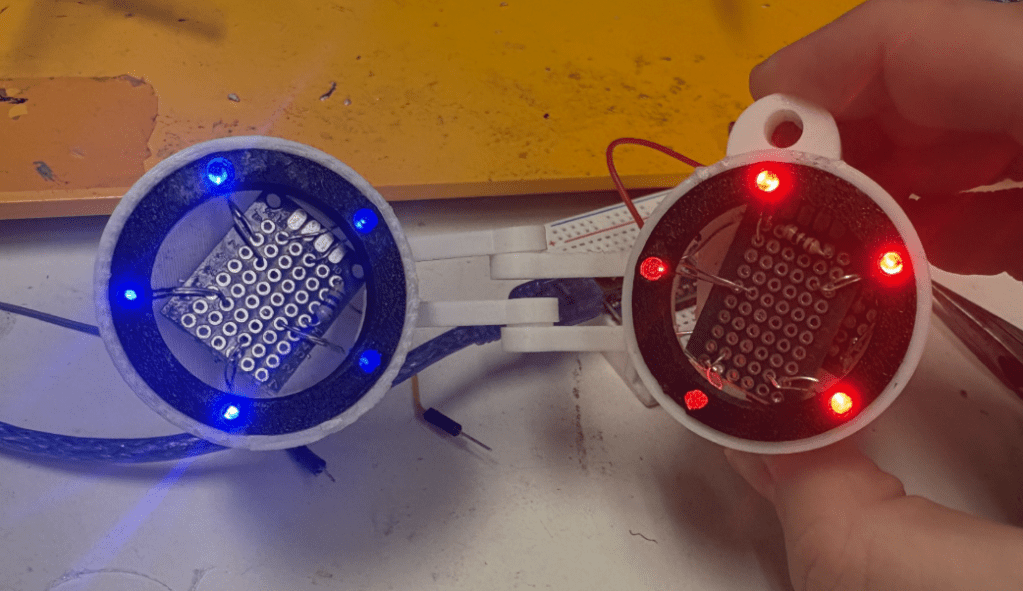
The first iteration of the ornament design. This version failed in test due to lack of space in the hinges.
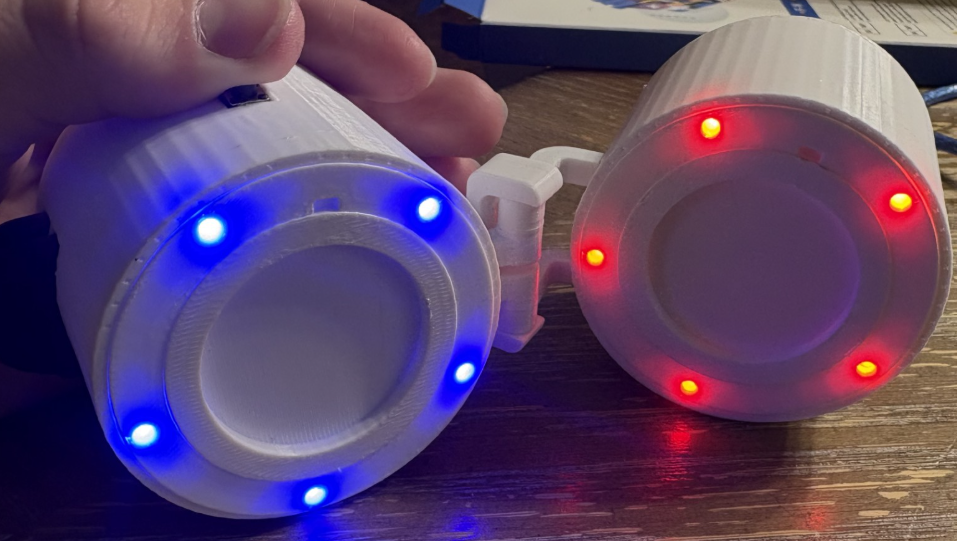
The final design of the ornament. This version had increased size and a cleaner hinge design
Results
This project successfully delivered the model as set for in the Objectives section. Notably, the ornament required a redesign halfway through construction due to insufficient clearance in the hinge calculations. Additionally, I not only designed, but had to construct the ornament myself. This constraint forced me to consider the feasibilty of the construction in my design, which is principle I intend to carry with me through my career.
Overview
Energy conservation is a pressing topic across academic institutions, particularly in university communities where the forefront of conservational research occurs. As a result, universities are highly aware of their energy costs and environmental impact, and understand their need to improve energy efficiency in those regards. Thus, the goal of this project was to create a design that could alleviate energy issues on college campuses such as Virginia Tech’s Blacksburg Campus.
This project looked to alleviate these energy issues by pursuing mechanical energy harvesting. For this, a design team of six individuals was formed, split evenly between Mechanical and Electrical Engineering students. After scoping the energy problem and assessing internal technical capabilities, the team elected to pursue the design of a mechanical piezoelectric plate.
Requirements/Constraints
- The project must deliver a piezoelectric plate prototype that is successful in generating electrical energy primarily through kinetic action.
- A prototype was to be delivered within three months of project’s beginning. Therefore, any prototype presented was required to be rudimentary in nature and focused on a proof of concept design.
- The materials provided for project design and construction were either open source (LTSpice) or provided by Virginia Tech (Frith Lab, SOLIDWORKS, AutoCAD).
Design Process
- Scoping of the project took place to assess possible energy harvesting strategies. The piezoelectric plate was chosen given the high volume of foot traffic on the Blacksburg Campus. Additionally, the team was divided into Mechanical and Electrical subteams. I served as Team Lead, coordinating internal deadlines and design integration in addition to technical electrical duties.
- After deciding on a prototype, the Electrical subteam modeled a circuit for the piezoelectric plate. It included an AC source to model piezoelectric motion, rectifying diodes to convert AC to DC, capacitance to store charge between activations, and an LED to simulate delivery to a load.
- Concurrently, the Mechanical subteam modeled a rack-pinion system for the plate depression into motor activation.
- After modeling, a prototype was prepared for demonstration at Virginia Tech’s Frith Lab. Notably, this version of the plate circuit was completely DC thanks to component specifications removing the need for AC.
- The finished prototype was presented at Design Showcase in December 2025.
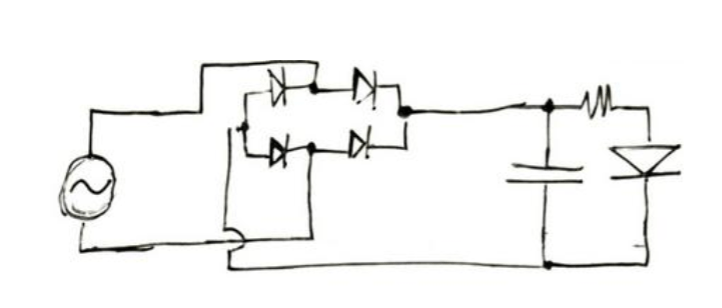
An early version of the plate’s electric circuit. This version assumed an AC source to account for rack backspin, and as such, a rectifier was include in the circuit.
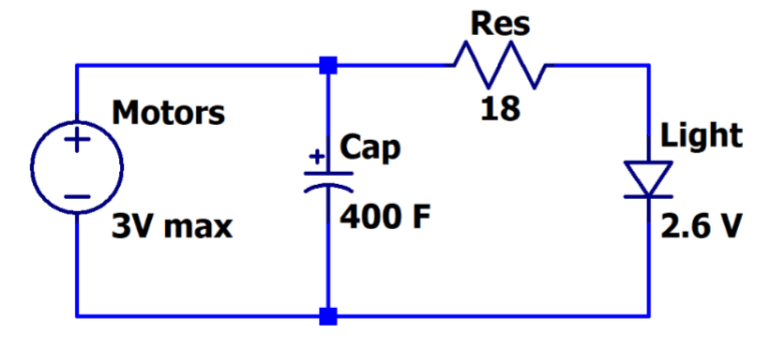
The final model of the plate circuit. This version held higher capacitance for smoother energy and no longer required a rectifier
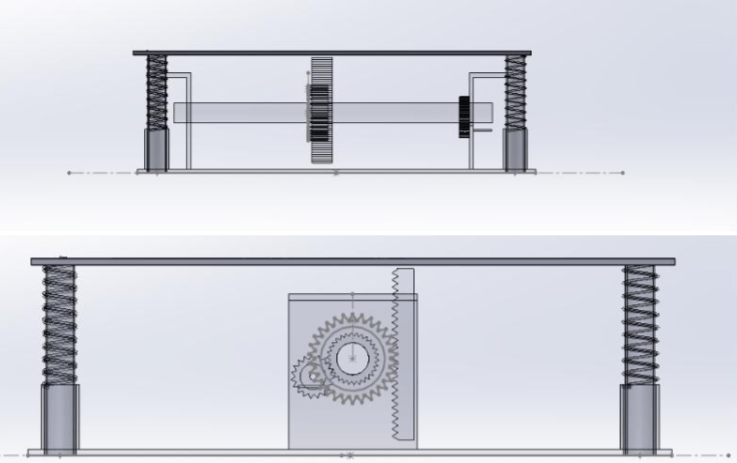
An early CAD model of the plate’s mechanical system. This system was simplified in the final version.
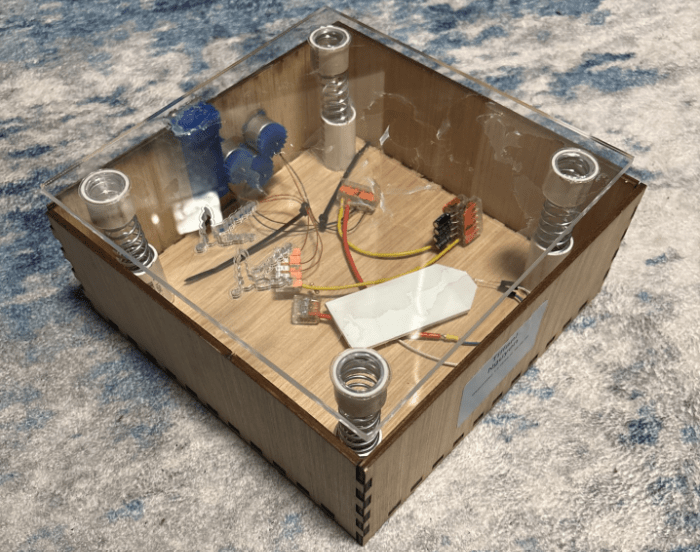
The final prototype as presented at Design Showcase.
Results
This project was successful in designing a rudimentary plate capable of mechanical-to-electrical energy conversion. Research concluded a single plate would receive approximately 20 steps per minute. Thus, the current rudimentary version produced .027 J of electrical energy per minute, corresponding a power output of .45 mW.
Given this project’s short development time and low energy output, there is a vast number of directions for this project to improve. Possible avenues include improvements in constructive material such as carbon fiber, advancements in the electrical circuit (i.e. wiring a battery to better store energy), or in increase in motor count to allow for more energy output at the expense of material cost.
Overview
Cancer is a disease defined by its uniqueness in every patient and the unpredictable nature in which it spreads. Because of its individualized nature, cancer treatments should be individualized as well. As a result, knowing exact the genetic mutations within a patient’s genome could prove instrumental in identifying the mode and severity of the patient’s disease. This was accomplished computationally by analyzing a type of genetic information called a transcriptome.
Requirements/Constraints
- The program written must be successful in identifying mutations in a genetic sequence via a transcriptome. It needs to be tested to ensure that false positives are not a frequent or extensive issue
- The program must be computationally efficient in its application.
- The program must be accessible in design and function, so open source tools such as the Ubuntu OS, Linux apps “samtools” and “bcftools”, the “SRA Toolkit” provided publicly by the National Center for Biotechnology Information (NCBI), and the Burrows-Wheeler Aligner (“bwa”).
- Due to financial constraints, the program was developed on a resource minimal laptop. This constraint also ensured that the program written would have higher accessibility thanks to its lower spec requirements
- Research on and practice with transcriptomic tools took place intermittently between November 2023 and October 2024. Tool development took place from October 2024 to January 2025 over the course of 12 weeks.
Design Process
- Linux Ubuntu was installed onto a computer with Python3 the following command line tools: “samtools”,”bcftools”, “SRA Toolkit.”
- A custom Python library, “alexandria,” was written, containing definitions of the Linux commands used in this project.
- A main script, “AML”, would collect an SRR number from the user and locate all genetic mutations within the transcriptomic sample,
- Note: An SRR number is a specific code tied a sample in NCBI’s Sequence Read Archive,
- “AML” output a .VCF (variant call format) file, which could then be analyzed as the end user saw fit.
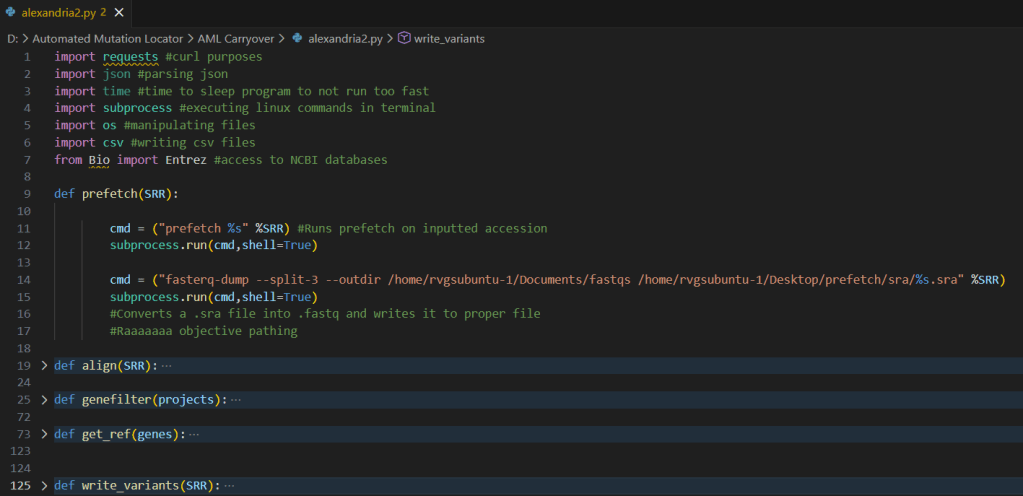
Pictured above is a snippet of the “alexandria” library. Note the use of the “subprocess” module used to interact with the command line.
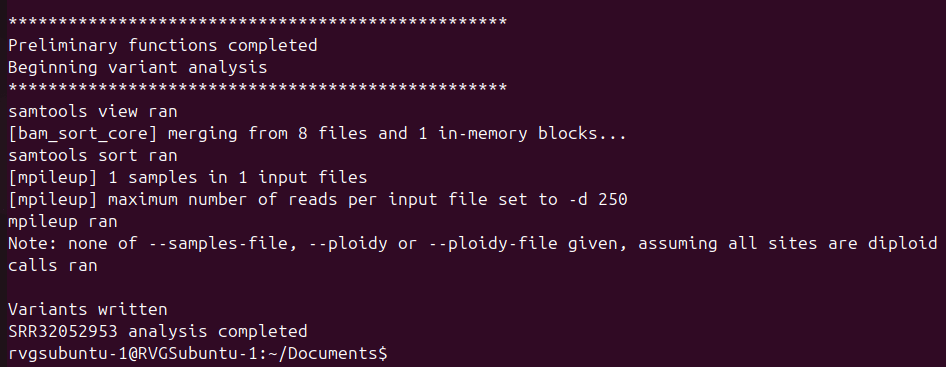
Picture above is the Linux Ubuntu terminal running the “AML” program. This specific process wrote the variants to a .VCF file that were then analyzed in post-development
Results
The tool developed for this project was successful in identifying genetic mutations from a transcriptome sample. Execution time varied based on transcriptome run size, but the program parsed at a rate of approximately 16.8 million reads per hour, which averaged to approximately 1.5 hours for a random transcriptome.
To test the tool’s effectiveness, ten mutation samples from patient’s of lung adenocarcinoma (LUAD) were compared with the genomes of ten healthy individuals. It was hypothesized that specific mutation ranges would be positively correlated with the patient’s LUAD status. This hypothesis was proven true, with mutations in the gene SFTPC being associated with the LUAD group.
Expansions on this tool include further extensive testing to improve accuracy and the addition of a front end to the tool since the current version runs directly on the command line.
Overview
A problem faced by any business that produces goods is how they transport their goods from their production site to the locations at which they sell. Colloquially, this is referred to as the “Traveling Salesman” problem. American businesses in particular stand to benefit from using this to navigate roads and interstates given how car-focused US infrastructure is.
This project, built using the Google Maps API (GMA), would receive a list of addresses from the user and return the order of routes with the shortest travel time over road.
Requirements/Constraints
- The program must be successful in collecting addresses, measuring the travel time/distances between them using the GMA, identifying the shortest possible route, and then returning it to the user.
- The program must be accurate in its assessment and selection of the shortest possible route.
- The program had a six week development period followed by a presentation cycle.
Design Process
- A custom library “bcommand” was written to interface with the GMA for actions such as collecting distances, travel times, or locating addresses.
- A second script “PRC” was written that collected the addresses from the user and performed the minimal route calculation via bcommand.functions. It also collected the locations from which the user would start and end their route.
- PRC returned the optimal route order to the user and displayed a map of this via the web browser.
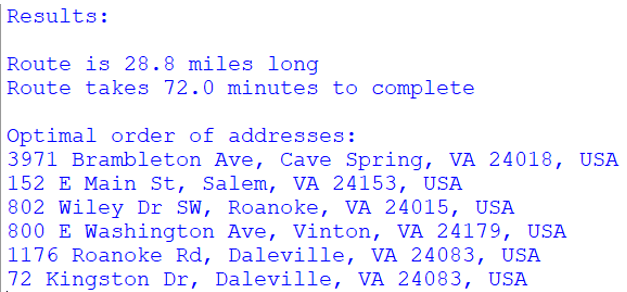
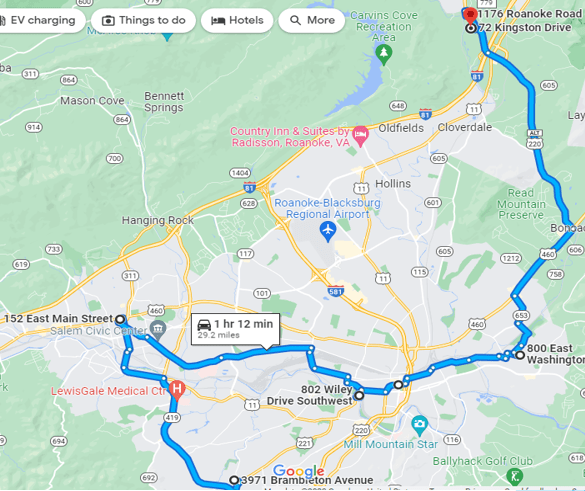
Top: The shell output of the program showing the optimal order of the inputted addresses
Bottom: Google Maps displaying the optimal route
Results
This program was successful in identifying and returning optimized overland routes to the user. Testing was successful up to five different addresses.
The current version of this program utilizes a brute-force approach. While appropriate for the development period and level of experience, future versions of this project could include calculation optimizations such as parallel processing or direct terminal interfacing.
This project went on to be presented at the Virginia State Science and Engineering Fair in April 2023. It also won a Special Award for Outstanding Presentation at the 2023 RVGS Project Forum.
Like what you see? Let’s connect!
Email: mbrendenhartung@gmail.com
LinkedIn: https://www.linkedin.com/in/brenden-hartung-897a54382/
 Brenden Hartung - Project Portfolio